Payout
With PagaSul, you can send money directly to your customers' bank accounts or Pix keys.
Here is a step-by-step description of the payout processing flow in PagaSul.
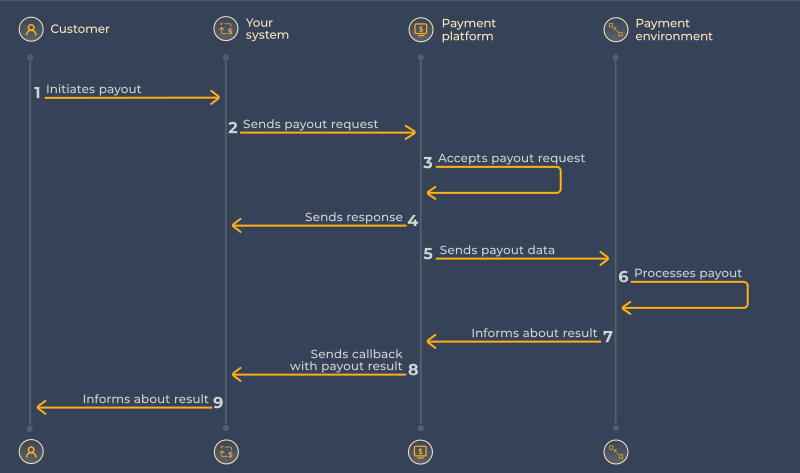
How to integrate
1. Create a pay-out
Send a POST request to /v2/pay-out. Include a signature in the header, and specify the payment method and the beneficiary's account details.
curl -X POST https://api.pagasul.com/v2/pay-out \
  -H "Content-Type: application/json" \
  -H "signature: <calculated>" \
  -d '{
    "client_id": 123,
    "client_payment_id": "payout_42",
    "amount": 150.00,
    "currency": "BRL",
    "payment_method": "BR.PIX",
    "payee": {
      "id": "user_1234",
      "cpf": "231.002.999-00"
    },
    "payee_account": {
      "pix_key": "johndoe@example.com",
      "pix_key_type": "EMAIL"
    },
    "payment_options": {
      "callback_url": "https://your-site.com/webhook"
    }
  }'
client_payment_id must be unique per payment in your system — it is used for idempotency.
The required payee_account fields depend on the payment method. For example, a Colombian bank transfer requires payee_account.number, payee_account.account_type, and payee_account.bank_code. See Payment Methods for the exact requirements per method, and Bank List for valid bank_code values.
Full parameter list
| Parameter | Type | Required | Description |
|---|---|---|---|
| client_id | integer | Yes | Your account identifier, provided upon integration |
| client_payment_id | string | Yes | Your payment ID, must be unique to the client_id used |
| payment_method | string | Yes | Selected payment method code (see Supported payment methods section) |
| currency | string | Yes | Payment currency (see Supported payment methods section) |
| amount | decimal | Yes | Requested payment amount (for example: pass 12.34 for 12 dollars 34 cents amount) |
| payee | object | Yes | Customer data section |
| payee.id | string | Yes | A unique identifier for a customer or customer account on your side. It is used to accumulate customer data and for anti-fraud protection |
| payee.is_trusted | boolean | Optional | If passed and "true" customer marked as trusted (for use please consult Pagasul representative) |
| payee.name | string | Optional | Customer name |
| payee.email | string | Optional | Customer email |
| payee.country | string | Optional | Customer country (alpha-2 code) |
| payee.state | string | Optional | Customer state |
| payee.city | string | Optional | Customer city |
| payee.address | string | Optional | Customer address |
| payee.phone | string | Optional | Customer phone |
| payee.language | string | Optional | Preferred language for customer |
| payee.cpf | string | Optional | Customer CPF (Cadastro de Pessoas Físicas) for Brazil payment methods. Can be passed in following formats: "231.002.999-00" or "23100299900" |
| payee.cuit | string | Optional | Customer CUIT (Unique Tax Identification Code) for Argentina payment methods. Can be passed in following formats: "30-69330706-2" or "30693307062" |
| payee.citizenship_card | string | Conditional | Number of the Citizenship Card (Cédula de Ciudadanía) for Colombian/Ecuadorian payment methods |
| payee.nit | string | Conditional | Unique Taxpayer Number (Número de Identificación Tributaria) for Colombian/Bolivian payment methods |
| payee.pas | string | Optional | Passport needed for Bolivian/Ecuadorian payment methods |
| payee.ce | string | Optional | Customer Identity card of Foreigners (Cédula de Extranjería) for Colombian payment methods |
| payee.ti | string | Optional | Customer identity document (Tarjeta de Identidad) for Colombian payment methods |
| payee.ci | string | Optional | Customer identity document (Cédula de Identidad) for Bolivia/Venezuela payment methods. For Venezuela it must start with letter V or E |
| payee.ruc | string | Optional | Ecuadorian taxpayer number (Registro Único de Contribuyente) |
| payee.rif | string | Optional | Venezuela's tax number (Registro de Información Fiscal). It must start with letter V, E, P, J, G, or C |
| payee_account | object | Yes | Customer account data for payment |
| payee_account.pix_key | string | Conditional | Required for Pix method. Key for Pix account. One of the following: CPF, CNPJ, E-mail, Phone, EVP |
| payee_account.pix_key_type | string | Conditional | Required for Pix method. Type of pix key value. One of: CPF, CNPJ, EMAIL, PHONE, EVP |
| payee_account.breb_key | string | Conditional | Required for Bre-b method. Key for Bre-b account. One of the following: E-mail, Phone, ID (Cédula), Alpha-Numeric Code (user-generated alias) |
| payee_account.account_type | string | Conditional | Type of account number passed in number parameter. (Mandatoriness see in section Supported payment methods). One of: CACC, SVGS |
| payee_account.number | string | Conditional | Bank account number or mobile phone number that links to bank account (Mandatoriness see in section Supported payment methods) |
| payee_account.bank_code | string | Conditional | Payee bank code (Mandatoriness see in section Supported payment methods). One of bank code from list (see Bank Codes section) |
| payee_account.holder_name | string | Conditional | Bank account holder name. Required for Argentina bank transfers (Mercado Pago) method |
| payment_options | object | Optional | Optional section for extra parameters used for payment flow adjustment |
| payment_options.callback_url | string | Optional | If passed, the notification on payment status change will be sent to the specified URL |
| payment_extra_param | string | Optional | Please, contact to your manager for possible parameter values and purpose |
Also the full parameter list, see Create pay-out in the API Reference.
2. Handle the response
A successful request returns a 200 response with status: "new":
{
  "payment_id": 246001235,
  "status": "new",
  "result_code": "OK",
  "result_message": "payment processing"
}
Store the payment_id — you'll need it to correlate callbacks. For the full response structure, see Response.
3. Handle the callback
When the payout is processed, PagaSul sends a POST to your callback_url. Verify the signature in the header, then check the status field:
| Status | Meaning | Action |
|---|---|---|
success | Payout delivered | No action required |
decline | Payout declined | Check result_code, notify the customer |
failed | Processing error | Contact PagaSul support |
For all statuses and result codes, see Statuses & Codes. For the full callback structure, see Callbacks.